
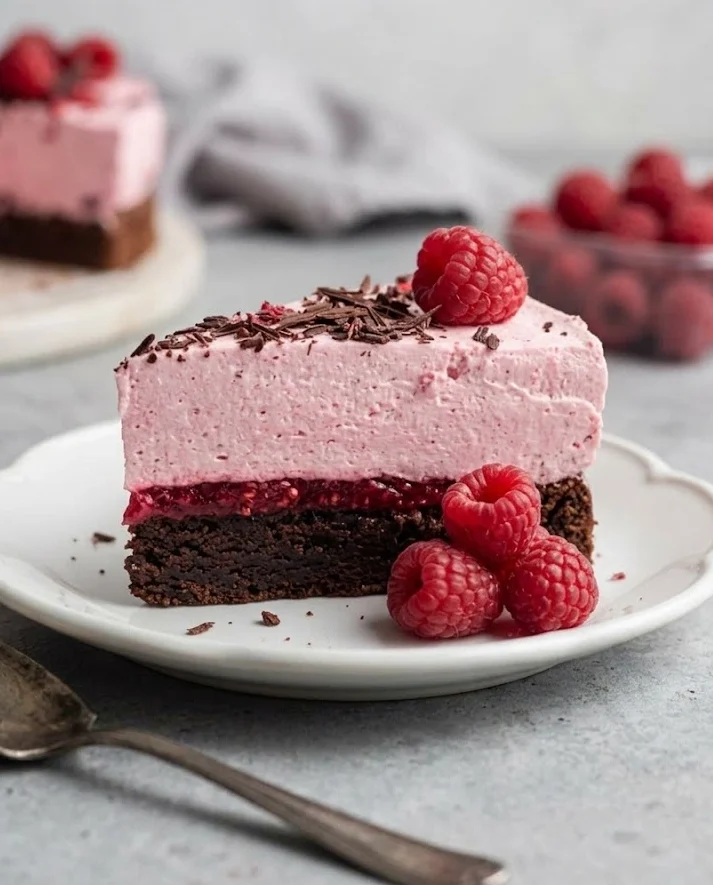
There is a type of dessert recipe that stops people mid-conversation the moment it arrives at the table. This Chocolate Raspberry Mousse Cake is exactly that. It does not rely on towering layers of buttercream or elaborate decoration to make an impression — it lets two extraordinary components speak entirely for themselves.
At the base sits a chocolate genoise sponge: light, airy, and fat-free in the traditional French style. On top of it, a breathtaking cloud of fresh raspberry mousse — silky, fruity, and barely sweet — sets overnight in the fridge into something that holds its shape like a dream and melts the moment it hits your tongue. Crowned with a pile of fresh raspberries and dark chocolate shavings, this is the kind of dessert recipe chocolate and fruit lovers dream about.
It requires patience and a few steps. But every single one of them is worth it.
Why You’ll Love This Dessert Recipe
This is one of those dessert recipes that manages to feel both luxurious and light at the same time — a genuinely rare combination. Neither the sponge nor the mousse is heavy, which means you can comfortably serve it after a full meal without anyone pushing their plate away. It is refreshing, fruity, and rich in all the right ways.
It is also one of the most make-ahead-friendly dessert recipes in the cake category. The entire cake is assembled the night before and simply pulled from the fridge when you are ready to serve. There is no last-minute frosting, no rushing, no stress — just a stunning finished dessert waiting for you with zero morning effort required.
Whether you are making it for Valentine’s Day, a birthday, a dinner party, or just because raspberries and chocolate is one of the greatest flavor combinations in the world, this recipe delivers a result that looks and tastes far more difficult than it actually is.
Common Mistakes (And How to Avoid Them)
Not whipping the eggs and sugar long enough for the sponge. The entire structure of a genoise sponge depends on the air beaten into the eggs and sugar at the start. You need to whip them for a full four minutes until the mixture is pale, thick, and leaves a visible ribbon trail on the surface when you lift the whisk. Stopping too early results in a flat, dense sponge that will not support the weight of the mousse.
Over-mixing when adding the dry ingredients. Once you sift in the flour and cocoa, switch to the lowest speed immediately. You are looking for just a few flour streaks remaining before you add the melted chocolate. Over-mixing at this stage deflates all the air you worked to incorporate and toughens the sponge.
Letting the raspberry puree cool insufficiently before folding into the cream. If the puree is still warm when it meets the whipped cream, it will deflate the cream on contact and the mousse will not hold its structure after setting. The puree needs to reach full room temperature — about 20 minutes off the heat — before you fold it in, in three careful additions.
Boiling the gelatine. This is one of the most common and most damaging mistakes in any mousse dessert recipe. Boiling gelatine destroys its setting ability entirely. Heat the puree gently to a simmer, add the bloomed gelatine, and stir with patience. Keep the temperature low and controlled at all times.
Not chilling for long enough. Three hours is the absolute minimum refrigeration time for this dessert recipe. Overnight is strongly recommended and produces a noticeably better texture — firmer, more sliceable, and with cleaner, more defined layers when cut.
Chef’s Notes
Use 75% dark chocolate for the sponge. The higher cacao percentage gives the base a genuine bitterness and depth that balances the sweetness of the raspberry mousse above it. Milk chocolate or lower percentage dark chocolate will make the sponge taste flat and overly sweet in comparison.
Do not skip the espresso powder. It does not make the cake taste like coffee — it amplifies the chocolate flavor in the same way salt amplifies sweetness. A half teaspoon is all it takes, and the difference it makes is significant.
When the sponge comes out of the oven, the top will look wrinkled and uneven. This is completely normal for a genoise and is not a sign that anything has gone wrong. Once the sponge has cooled to room temperature, use the flat base of a glass or measuring cup to gently press the surface flat. This creates the clean, even layer you want underneath the mousse.
For the cleanest, most photogenic slices, run a long sharp knife under warm water, wipe it dry, and slice through in one smooth downward motion. Repeat the warming and drying between every single slice. The layers will be razor-sharp and the colors will contrast beautifully.
Allow the cake to sit at room temperature for 20 to 30 minutes before serving. A very cold mousse is slightly muted in flavor — letting it temper slightly allows the full raspberry flavor to bloom and the texture to soften into something even more luxurious.
Key Ingredients
Dark chocolate (75% cacao) is the flavor anchor of the entire sponge. Its bitterness cuts through the natural sweetness of the sponge batter and creates a complexity that cheaper, lower-percentage chocolate simply cannot replicate. Use a good-quality eating chocolate — something like Lindt 75% Dark — rather than baking chocolate, which often lacks nuance.
Espresso powder is the silent partner in the chocolate sponge. Added in a small amount, it deepens and intensifies the chocolate flavor without introducing any coffee taste of its own. It is one of the most effective and underused techniques in all of dessert recipes chocolate baking.
Fresh raspberries are the star of the mousse layer and deserve to be the best quality you can find. Their natural tartness, juiciness, and vivid color are what make this mousse so extraordinary. When raspberries are out of season, frozen raspberries work — but thaw them in a colander first to drain all excess moisture before blending, or the puree will be too thin.
Powdered gelatine is what transforms the raspberry cream from a soft whipped topping into a mousse with structure and body that holds its shape when sliced. It must be bloomed correctly in cold lemon juice first before being gently dissolved into the warm puree. Using the right ratio is critical — measure by weight rather than volume for accuracy.
Lemon juice serves two functions in the mousse. It is the liquid used to bloom the gelatine, and its acidity cuts through the natural sweetness of the raspberries, sharpening and brightening the flavor significantly. Without it, the mousse tastes flat and one-dimensional.
Double cream (heavy cream) is the body of the mousse and must be full-fat — a minimum of 48% fat content. Only high-fat cream whips properly and holds its volume when combined with the raspberry puree. Lower-fat creams will not whip to the right consistency and will result in a mousse that never fully sets.
How to Make Chocolate Raspberry Mousse Cake
Step 1: Prepare your pan and preheat the oven. Grease and line the base and sides of a 9-inch springform pan with parchment paper, allowing the paper to overhang the top slightly. Preheat the oven to 350°F (180°C).
Step 2: Whip the eggs and sugar. Combine the eggs, both sugars, and vanilla extract in a large bowl. Using a hand-held electric whisk or stand mixer, beat on medium-high for four full minutes until the mixture is pale, thick, and leaves a ribbon trail on the surface.
Step 3: Fold in the dry ingredients. Sift the flour, cocoa powder, baking powder, espresso powder, and salt directly into the egg mixture. Mix on the lowest speed until just a few streaks of flour remain.
Step 4: Add the melted chocolate. Pour in the melted dark chocolate and fold gently with a rubber spatula until fully combined. Scrape the bottom of the bowl to ensure no chocolate has sunk and pooled there.
Step 5: Bake the sponge. Pour the batter into the prepared pan, tap the pan firmly on the counter twice to release air bubbles, and smooth the surface. Bake for 15 to 20 minutes, until the center springs back when lightly pressed. Cool completely in the pan on a wire rack, then press the wrinkled top flat with a glass base, cover, and refrigerate.
Step 6: Bloom the gelatine. Add the lemon juice to a small bowl. Sprinkle the powdered gelatine over the surface, stir with a fork, and leave for a couple of minutes to soften and expand.
Step 7: Make the raspberry puree. Blend the fresh raspberries until smooth in a food processor or blender. Pass through a fine-mesh sieve set over a saucepan, pressing with the back of a spoon to extract all the puree. Discard the seeds. You should have approximately 300ml (1¼ cups) of smooth puree.
Step 8: Heat the puree and dissolve the gelatine. Place the saucepan over medium-low heat, add the sugar, and stir until dissolved. Add the bloomed gelatine and stir gently, never allowing it to boil, until the gelatine is fully dissolved. Pass through a sieve one final time to remove any lumps. Allow to cool to room temperature — approximately 20 minutes.
Step 9: Whip the cream and fold in the puree. In a separate chilled bowl, whip the cold double cream to soft peaks. Fold the cooled raspberry puree into the cream in three additions, using a gentle scraping motion to preserve as much air as possible.
Step 10: Assemble and set. Pour the raspberry mousse directly over the chilled chocolate sponge in the springform pan. Smooth the surface with an offset spatula, cover, and refrigerate for a minimum of three hours — overnight for best results.
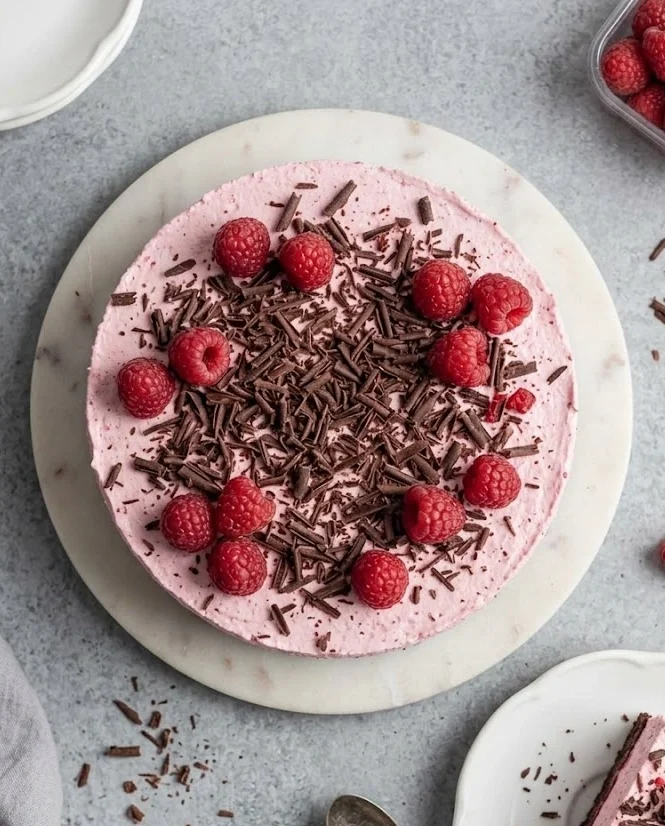
Step 11: Unmould, decorate, and serve. Remove the springform sides and peel away the parchment collar. Smooth any imperfect edges with a warmed offset spatula. Slide onto a serving plate and decorate generously with fresh raspberries and dark chocolate shavings. Slice with a warmed, dry knife and serve immediately.
Variations and Tips
Try other berries. This mousse technique works beautifully with blackberries, strawberries, or a mixed berry combination in place of raspberries. The process remains identical — blend, sieve, heat with gelatine, cool, fold into whipped cream.
Make it vegetarian. Replace the powdered gelatine with an equal amount of agar-agar powder for a fully plant-based mousse. Note that agar-agar sets firmer than gelatine, so the texture of the mousse will be slightly less silky.
Add a chocolate ganache finish. For an even more spectacular presentation, pour a thin layer of ganache — 100g dark chocolate melted into 100ml hot heavy cream — over the top of the fully set mousse before decorating with raspberries. Allow the ganache to set in the fridge for 30 minutes before serving.
Serve with raspberry coulis or chocolate sauce. A spoonful of either drizzled over each slice as it is plated transforms this dessert recipe into something truly restaurant-worthy. The coulis reinforces the fruit flavor; the chocolate sauce deepens the richness.
Swap the decoration. Rather than a free-form pile of raspberries, pipe rosettes of lightly whipped cream around the border of the cake and place a single perfect raspberry in the center of each swirl for a more structured, formal finish.
How to Meal Prep
This is one of the most practically designed dessert recipes for advance preparation. In fact, the recipe is built around make-ahead logic — the overnight refrigeration is not just convenient, it is actively better for the final result. A mousse that has chilled for 12 hours is firmer, cleaner-slicing, and more fully flavored than one chilled for just three.
The chocolate sponge can be baked up to two days in advance, covered, and stored in the springform pan in the refrigerator. The raspberry puree — before being combined with cream — can be stored in an airtight container in the refrigerator for up to two days, making it easy to break the recipe into separate sessions if needed.
The fully assembled cake stores beautifully in the refrigerator for up to five days, making it one of the most practical dessert recipes for a crowd, dinner party, or holiday entertaining. It can also be frozen for up to two months — wrap tightly in plastic wrap followed by a double layer of foil, and thaw overnight in the refrigerator before serving. Never apply heat to thaw it.
Cultural Context
Mousse as a dessert technique has its origins firmly in French cuisine. The word itself — meaning “foam” in French — describes the defining quality of the preparation: the incorporation of air into a base ingredient to create something lighter than its components suggest. French pastry chefs have been perfecting mousse preparations since at least the 18th century, when whipped cream first became a popular element in refined dessert recipes.
The chocolate mousse in its modern form — chocolate folded into whipped cream or beaten eggs — became a staple of French domestic cooking in the mid-20th century and spread rapidly through European and American home kitchens. The mousse cake, which uses a set mousse as a structural layer rather than a soft served dessert, emerged as a natural evolution in professional patisserie, where the marriage of a baked sponge base with a no-bake mousse topping allowed for make-ahead practicality without sacrificing elegance.
The genoise sponge used in this dessert recipe is itself a cornerstone of classical French and Italian baking — a whole-egg foam cake with no chemical leaveners that relies entirely on the air beaten into the eggs for its lift. It is one of the foundational techniques of European patisserie and the reason why this particular dessert recipe, despite its simplicity of ingredients, carries such a refined, bakery-quality result. The combination of chocolate and raspberry has been a beloved pairing in French confectionery for generations, and in this cake, it reaches its most effortless and accessible expression.

Chocolate Raspberry Mousse Cake
Equipment
- springform pan
- mixing bowls
- electric mixer
- spatula
- fine mesh sieve
- saucepan
Ingredients
- 4 eggs
- 100 g granulated sugar
- 50 g brown sugar
- 1 tsp vanilla extract
- 80 g all-purpose flour
- 25 g cocoa powder
- 1 tsp baking powder
- 1/2 tsp espresso powder
- 1/4 tsp salt
- 100 g dark chocolate (75%), melted
- 300 g fresh raspberries
- 100 g granulated sugar (for mousse)
- 2 tsp powdered gelatine
- 2 tbsp lemon juice
- 400 ml heavy cream
Instructions
- Preheat oven to 350°F (180°C) and prepare a lined 9-inch springform pan.
- Whip eggs, sugars, and vanilla for about 4 minutes until pale and thick.
- Sift in dry ingredients and mix gently on low speed until just combined.
- Fold in melted dark chocolate until smooth, ensuring no pockets remain.
- Pour batter into pan and bake for 15–20 minutes. Cool completely and refrigerate.
- Bloom gelatine in lemon juice and let it soften for a few minutes.
- Blend raspberries, strain seeds, heat gently with sugar, then dissolve gelatine. Cool to room temperature.
- Whip cream to soft peaks and gently fold in cooled raspberry mixture in batches.
- Pour mousse over chilled sponge, smooth the top, and refrigerate at least 3 hours or overnight.
- Remove from pan, decorate with raspberries and chocolate shavings, slice, and serve.