
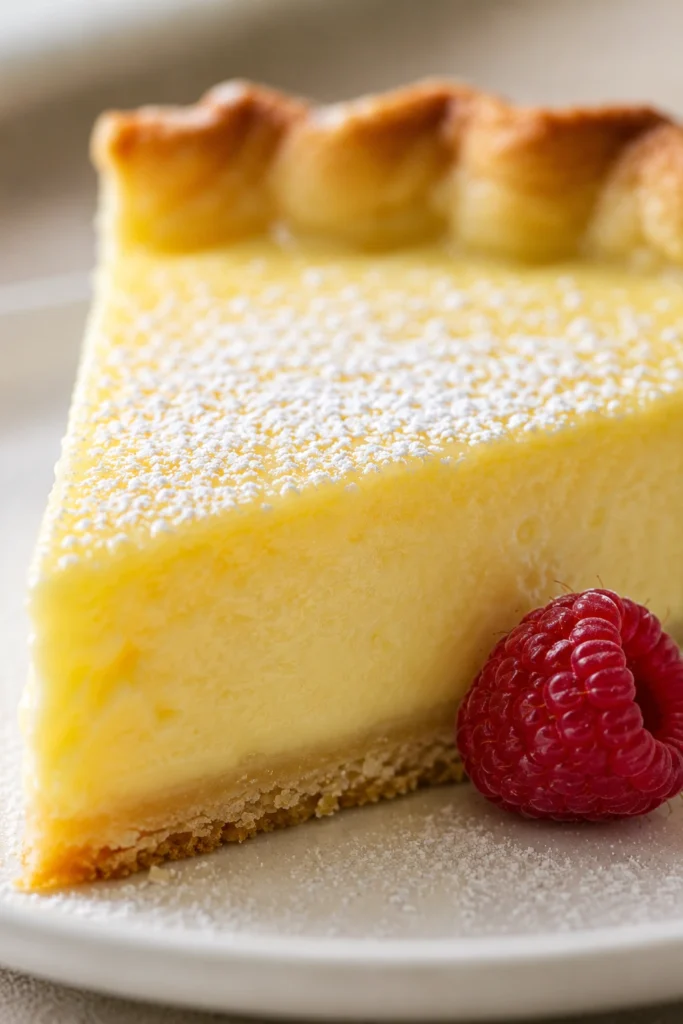
There are desserts that impress and desserts that comfort, and then there are the rare few that manage to do both simultaneously without any apparent effort. Lemon Custard Pie belongs firmly in that third category. It is elegant enough to serve at a dinner party, simple enough to make on a weekday afternoon, and universally beloved in a way that very few summer desserts ideas can claim.
The filling is the thing — a trembling, silky custard with a lemon flavor so bright and clean it almost feels like a palate cleanser as much as a dessert. Set in a buttery, golden pastry shell and served cold from the refrigerator, it is one of those summer desserts cold and refreshing that earns its place on the table on the hottest days of the year.
Why You’ll Love This Lemon Custard Pie
This recipe sits at the top of the summer desserts with fruit category not because it is laden with fruit — though fresh berries alongside it are extraordinary — but because it celebrates the lemon in its purest, most concentrated form. Every element is built to amplify that bright citrus flavor rather than compete with it.
It is also one of the most practical summer desserts easy recipes for entertaining because it must be made ahead. There is no last-minute assembly, no plating under pressure, and no keeping anything warm. Make it the day before, refrigerate it overnight, and bring it to the table cold and perfectly set. The pie actually improves with overnight refrigeration as the flavors deepen and the custard firms to its ideal sliceable consistency.
For anyone managing a mixed group of guests, this ranks among the most accommodating summer desserts for a crowd. The flavor is universally appealing — not too sweet, not too tart, not too rich — and the portion sizes are naturally controlled by the pie format. It is the kind of summer desserts for party situations where you need something that works for everyone from the most adventurous dessert lover to the person who claims they do not really like dessert.
Common Mistakes — And How to Avoid Them
Not blind baking the crust. A lemon custard filling is liquid when it goes into the pie shell, and a raw pastry base will absorb that liquid before it has a chance to set, resulting in a soggy, underbaked bottom crust. Blind baking — pre-baking the empty shell with pie weights before adding the filling — is a non-negotiable step that ensures a crisp, fully cooked base that holds its structure beautifully under the custard.
Adding hot lemon mixture to eggs without tempering. If you pour hot liquid directly onto beaten eggs, you will scramble them instantly and ruin the custard. Tempering — gradually adding small amounts of the hot mixture to the eggs while whisking constantly before combining everything — is the technique that produces a silky, lump-free custard. Take this step slowly and deliberately.
Overbaking the custard. A perfectly baked lemon custard should have a gentle wobble in the center when the pie is removed from the oven — similar to a set jello that has not quite fully firmed. It will continue to set as it cools. An overbaked custard loses its silky texture and becomes grainy, dense, and cracked. Pull it from the oven while it still moves slightly in the center.
Using bottled lemon juice. As with all lemon-forward summer desserts, fresh lemon juice is the only acceptable option here. Bottled juice has a flat, slightly metallic quality that becomes very apparent in a custard where lemon is the primary flavor. You will need approximately four to five large lemons for this recipe — for both juice and zest.
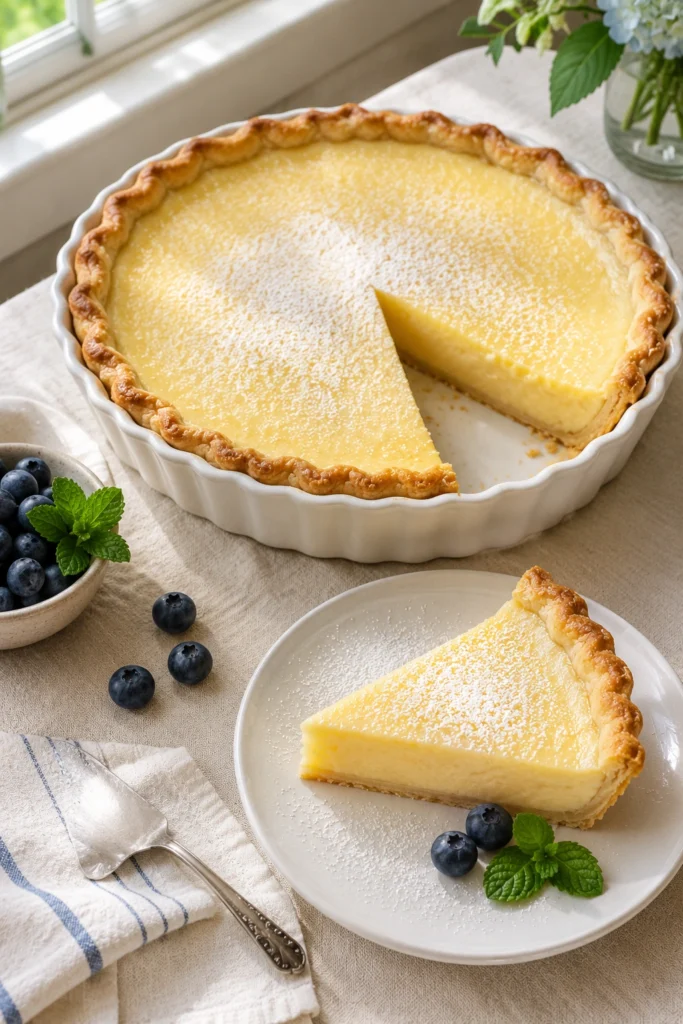
Key Ingredients for Lemon Custard Pie
Fresh Lemons The entire identity of this pie rests on the quality and quantity of fresh lemon. Both the juice and the zest are used — the juice provides acidity and liquid volume, while the zest carries the concentrated aromatic oils that give the custard its intensely bright, floral lemon character. Do not underestimate the zest. It is often the difference between a pie that tastes pleasantly lemony and one that tastes vibrantly, unmistakably alive.
Whole Eggs and Egg Yolks The custard uses a combination of whole eggs and additional yolks. Whole eggs provide structure and set, while the extra yolks contribute richness, a deeper golden color, and the velvety, luxurious mouthfeel that distinguishes a truly exceptional custard from an ordinary one. Do not be tempted to reduce the yolk count — they are doing essential textural work.
Heavy Cream and Whole Milk The custard base is a combination of heavy cream and whole milk rather than cream alone. Cream provides richness and body; milk lightens the texture and prevents the filling from becoming too dense or overly rich. The ratio of cream to milk determines the final texture — more cream produces a firmer, richer set, while more milk produces something closer to a classic egg custard tart.
Caster Sugar Fine caster sugar dissolves completely into the custard base without any graininess. The quantity is calibrated to balance the acidity of the lemon rather than overwhelm it — this is not a sweet pie in the conventional sense, but rather a perfectly balanced one where every element is in proportion.
Blind-Baked Shortcrust Pastry Shell Whether you make your own or use a high-quality store-bought shell, the pastry is the structural foundation of the entire pie. A good shortcrust for this recipe should be buttery and slightly crisp — with enough body to hold a liquid custard filling without becoming soft. Adding a small amount of powdered sugar to a homemade shortcrust (creating a pâte sucrée) produces a slightly sweeter, more tender shell that complements the custard beautifully.
Vanilla Extract A small amount of pure vanilla extract deepens the custard flavor significantly. It does not compete with the lemon — rather, it adds a warm, rounded quality that makes the overall flavor more complex and satisfying. Think of it as the low note that makes the bright lemon sing more clearly by contrast.
How to Make Lemon Custard Pie
For the Shortcrust Pastry Shell:
- Make or prepare the pastry. If making from scratch, combine 190g (1.5 cups) of all-purpose flour, 2 tablespoons of powdered sugar, and 1/4 teaspoon of fine salt. Add 115g (1/2 cup) of cold cubed unsalted butter and rub together until the mixture resembles coarse crumbs. Add 2 to 3 tablespoons of ice cold water one tablespoon at a time, mixing until the dough just comes together. Flatten into a disk, wrap in plastic wrap, and refrigerate for at least 30 minutes.
- Roll and line the tin. Roll the chilled pastry on a lightly floured surface to approximately 3mm (1/8 inch) thickness. Carefully drape over a 23cm (9-inch) deep pie tin and press gently into the base and sides. Trim the overhang to 1cm (1/2 inch) and fold it back on itself to create a neat, slightly raised edge. Refrigerate the lined tin for 20 minutes.
- Blind bake. Preheat your oven to 190°C (375°F). Line the chilled pastry shell with parchment paper and fill with pie weights or dried beans. Bake for 15 minutes. Remove the weights and parchment and bake for a further 8 to 10 minutes until the base is lightly golden and dry to the touch. Remove from the oven and reduce the temperature to 160°C (325°F).
For the Lemon Custard Filling:
- Zest and juice the lemons. Zest three large lemons and juice four to five to produce 120ml (1/2 cup) of fresh lemon juice. Set aside.
- Warm the cream and milk. In a medium saucepan, combine 240ml (1 cup) of heavy cream and 120ml (1/2 cup) of whole milk. Add the lemon zest. Heat over medium-low heat, stirring occasionally, until the mixture just begins to steam and tiny bubbles form around the edges — do not boil. Remove from heat and allow to infuse for 10 minutes.
- Whisk eggs and sugar. In a large bowl, whisk together 3 large whole eggs and 3 large egg yolks with 150g (3/4 cup) of caster sugar until the mixture is pale, smooth, and slightly thickened. Add 1/2 teaspoon of pure vanilla extract and whisk to combine.
- Temper the eggs. Slowly pour the warm cream mixture into the egg mixture in a thin, steady stream, whisking constantly throughout. Do not rush this step. Once fully combined, strain through a fine mesh sieve into a large jug to remove the zest and any cooked egg particles.
- Add lemon juice. Stir the fresh lemon juice into the strained custard base. The mixture will thin slightly and lighten in color.
- Pour and bake. Place the blind-baked pastry shell on a baking sheet. Pour the custard filling slowly and carefully into the shell, filling it almost to the top. Slide the baking sheet carefully into the 160°C (325°F) oven.
- Bake low and slow. Bake for 35 to 45 minutes until the edges of the custard are set and the center retains a gentle, uniform wobble when the pan is nudged. The surface should appear matte rather than glossy and should not ripple freely.
- Cool completely. Remove from the oven and allow to cool on a wire rack to room temperature — at least one hour. Do not refrigerate while still warm, as condensation will form on the surface of the custard.
- Refrigerate overnight. Cover loosely and refrigerate for a minimum of 4 hours, ideally overnight. Serve cold, dusted with powdered sugar and accompanied by fresh berries or whipped cream.
Variations and Tips
Summer Desserts Gluten Free: Replace the all-purpose flour in the pastry with a 1:1 gluten free baking flour blend. Gluten free shortcrust pastry is slightly more fragile to handle — keep it well chilled throughout and patch any cracks by pressing gently with damp fingers. The custard filling is naturally gluten free and requires no modification whatsoever.
Summer Desserts Healthy Option: Reduce the sugar in the custard to 120g (just over 1/2 cup) — the lemon’s natural acidity will become slightly more pronounced but in a way that many people find more refreshing than the standard version. Replace one of the additional egg yolks with an extra egg white to reduce the fat content without significantly compromising the texture.
Summer Desserts with Fruit: Serve each slice with a spoonful of fresh blueberry or raspberry compote alongside — the tartness of the berries mirrors the lemon beautifully and the color contrast against the pale yellow custard is visually stunning. A scattering of fresh strawberry slices and a dusting of powdered sugar transforms each plate into something worthy of a restaurant dessert menu.
Summer Desserts for Kids: Add an additional tablespoon of sugar to the custard and serve with a generous swirl of whipped cream and a few fresh berries. The slightly sweeter balance and the familiar accompaniments make it one of the most successful summer desserts for kids who might otherwise be cautious about a custard-forward dessert.
Pro Tip: For the most spectacular presentation, use a kitchen torch to lightly caramelize a thin, even layer of caster sugar on the surface of the chilled pie immediately before serving — essentially creating a crème brûlée-style topping on a lemon custard pie. The crackling caramel surface against the cold, silky custard beneath is one of the most extraordinary textural experiences in the summer desserts ideas playbook.

How to Meal Prep Lemon Custard Pie
Lemon Custard Pie is perhaps the single most make-ahead-friendly dessert in the entire summer desserts for a crowd category, and this is not a compromise — it is a genuine quality advantage. The pie must be made ahead to reach its ideal texture, and it holds its quality for longer than almost any other custard-based dessert.
The pastry shell can be blind baked up to two days in advance and stored at room temperature in the tin, loosely covered. This removes the most time-intensive step from the day of assembly entirely.
The completed pie — custard baked and fully cooled — keeps beautifully in the refrigerator for up to three days. The custard does not weep, the crust does not soften significantly, and the flavor deepens day by day. A pie made two days before your event will taste more complex and fully developed than one made the morning of.
For very large gatherings, consider making the pie in a rectangular tart tin rather than a round pie dish. A 35x11cm (14×4 inch) rectangular tart tin produces a pie that slices into elegant rectangular portions — more servings per pie, easier to plate uniformly, and visually striking on a dessert table in a way that the conventional round format simply cannot match.
FAQs
Why did my custard crack on top? Surface cracking in a baked custard is almost always caused by overbaking or by a temperature that is too high. The proteins in the eggs tighten and contract as they cook, and when pushed beyond their ideal set point, they pull apart and crack. Baking at a low temperature — 160°C (325°F) — and removing the pie while the center still wobbles gently are the two most reliable protections against this. A cracked custard still tastes excellent but loses some of its visual elegance.
Can I make this pie without blind baking the crust? Technically yes, but the result will be a noticeably soggy bottom crust that lacks the structural integrity to hold clean slices. For a pie where the filling is the star, a properly blind-baked shell that provides a crisp, defined base makes an enormous difference in both texture and presentation. It is worth the extra 25 minutes.
How do I know when the custard is perfectly baked? The wobble test is your most reliable guide. Nudge the baking sheet gently — the outer 5cm (2 inches) of the custard should be set and move as a unit, while the very center should still have a slow, uniform jiggle. If the entire surface ripples freely like liquid, it needs more time. If there is no movement at all, it is likely overbaked. The sweet spot is a custard that behaves like a barely-set jello across the center third.
Can I freeze Lemon Custard Pie? Freezing is not recommended. Egg custard-based fillings do not thaw gracefully — the texture becomes grainy and weepy as the proteins break down during the freeze-thaw cycle. This pie is at its best served fresh from the refrigerator within three days of baking, which given its make-ahead nature is never a practical limitation for home entertaining.
Cultural Context
Custard tarts and pies have one of the longest and most geographically widespread histories of any dessert category in the world. From the Portuguese pastel de nata — a flaky, caramelized custard tart with roots in 18th-century Lisbon monastery kitchens — to the English custard tart that appeared in medieval recipe manuscripts as early as the 14th century, the combination of egg custard and pastry is one of humanity’s oldest and most instinctively satisfying culinary creations.
The lemon variation is a more recent development in this long history, emerging most prominently in the baking traditions of southern France and northern Italy, where citrus cultivation has been economically and culturally significant since the Renaissance. The sunny, lemon-growing regions of Provence and the Amalfi Coast produced kitchen traditions where lemon appeared not just as a garnish or an accent but as a primary, featured ingredient — a philosophy that this pie embodies completely.
In the American baking tradition, lemon custard pie occupies a slightly different cultural space than its European counterparts — sitting alongside lemon meringue pie and lemon chess pie as part of a broader family of Southern and Midwestern lemon desserts that have graced church suppers, county fair tables, and family reunion spreads for well over a century. Its endurance across so many different food cultures and time periods is the clearest possible evidence that some flavor combinations are not trends — they are simply, permanently true.
This Lemon Custard Pie, served cold on a hot summer day, is one of those permanent truths. Bright, elegant, and deeply satisfying, it belongs among the very finest summer desserts ideas not because it is fashionable but because it is genuinely, timelessly excellent.

Lemon Custard Pie
Equipment
- 9-inch pie tin
- Rolling Pin
- mixing bowls
- medium saucepan
- whisk
- fine mesh sieve
- baking sheet
- parchment paper
- pie weights or dried beans
- wire cooling rack
Ingredients
- 190 g all-purpose flour
- 2 tbsp powdered sugar
- 0.25 tsp fine salt
- 115 g cold unsalted butter, cubed
- 2-3 tbsp ice cold water
- 3 large lemons, zested
- 120 ml fresh lemon juice
- 240 ml heavy cream
- 120 ml whole milk
- 3 large whole eggs
- 3 large egg yolks
- 150 g caster sugar
- 0.5 tsp pure vanilla extract
- powdered sugar for dusting (optional)
- fresh berries for serving (optional)
- whipped cream for serving (optional)
Instructions
- Combine the flour, powdered sugar, and salt in a bowl. Cut in the cold butter until the mixture resembles coarse crumbs. Add ice water gradually until the dough comes together. Shape into a disk, wrap, and refrigerate for at least 30 minutes.
- Roll the chilled pastry to 3mm (1/8 inch) thick and line a 23cm (9-inch) pie tin. Trim and crimp the edges, then refrigerate the lined shell for 20 minutes.
- Preheat the oven to 190°C (375°F). Line the shell with parchment paper and pie weights. Bake for 15 minutes, remove the weights, then bake another 8 to 10 minutes until lightly golden. Reduce oven temperature to 160°C (325°F).
- Zest the lemons and juice enough lemons to yield 120ml (1/2 cup) fresh juice.
- In a saucepan, combine the heavy cream, whole milk, and lemon zest. Heat gently until steaming with tiny bubbles around the edges, then remove from heat and let infuse for 10 minutes.
- Whisk together the whole eggs, egg yolks, caster sugar, and vanilla extract until pale and smooth.
- Slowly pour the warm cream mixture into the egg mixture while whisking constantly to temper the eggs. Strain through a fine mesh sieve.
- Stir the fresh lemon juice into the custard base until fully combined.
- Place the blind-baked shell on a baking sheet and carefully pour in the custard filling almost to the top.
- Bake at 160°C (325°F) for 35 to 45 minutes until the edges are set and the center retains a gentle wobble.
- Allow the pie to cool completely on a wire rack for at least one hour before refrigerating.
- Cover loosely and refrigerate for at least 4 hours or overnight. Serve chilled with powdered sugar, berries, or whipped cream if desired.