
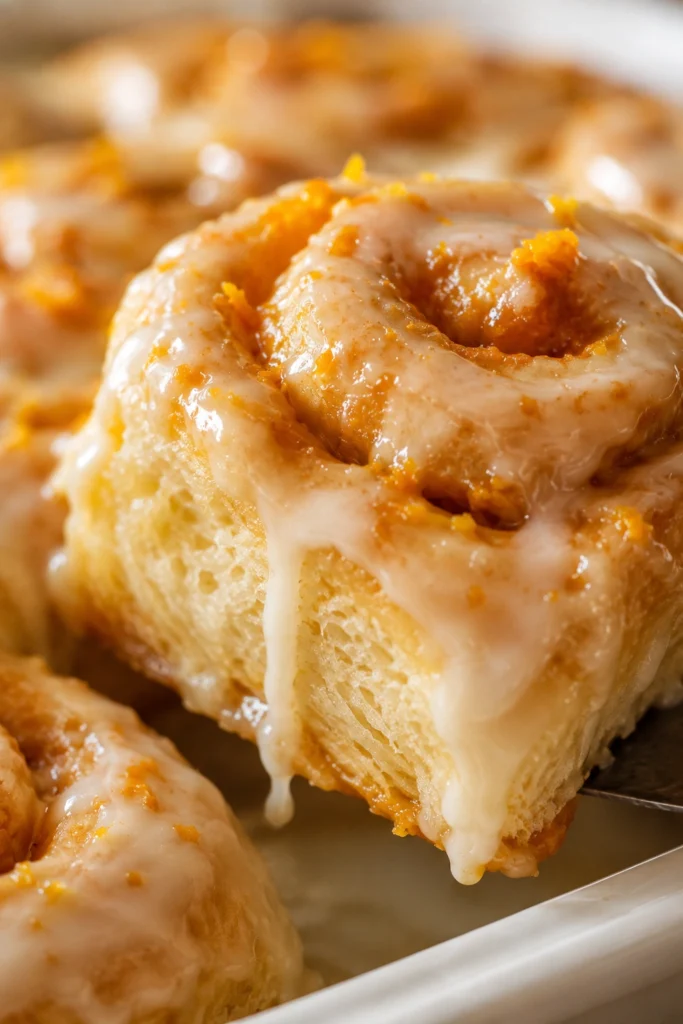
Close your eyes and think about the best summer dessert you ever had as a child. For millions of people, that memory involves a creamsicle — that iconic orange-and-vanilla frozen bar that seemed to perfectly capture everything summer was supposed to taste like. Bright, citrusy, cold, and creamy all at once. This recipe takes that exact flavor memory and transforms it into something you can pull apart at a kitchen table surrounded by people you love.
These Orange Creamsicle Rolls are soft, fluffy, and generously filled with a sweet orange-vanilla swirl, then finished with a tangy orange cream cheese glaze that drips into every crevice as it melts over the warm rolls. As summer desserts ideas go, this one is genuinely unexpected — and absolutely unforgettable.
Why You’ll Love These Orange Creamsicle Rolls
The flavor profile here is the first thing that earns this recipe its place among the best summer desserts with fruit on the internet. Fresh orange zest and juice run through every single component — the dough, the filling, and the glaze — creating a cohesive, fully realized citrus experience rather than a faint orange suggestion that fades after the first bite.
These rolls also sit comfortably in the category of summer desserts easy enough to make on a weekend morning with a cup of coffee beside you. The dough is forgiving, the filling comes together in minutes, and the glaze requires nothing more than a bowl and a whisk. There is no candy thermometer, no complicated shaping technique, and no specialized equipment required beyond a standard 9×13 baking dish.
For anyone hosting a brunch or a larger gathering, these are among the most practical summer desserts for a crowd in existence. They bake together in one pan, they are served at the table family-style, and they have the kind of pull-apart, share-everything energy that turns a meal into a genuine occasion. They are also summer desserts for kids that adults will fight over — which is always the highest possible endorsement.
Common Mistakes — And How to Avoid Them
Killing the yeast with liquid that is too hot. This is the most common and most devastating mistake in any yeast-based recipe. The milk used to activate the yeast must be warm — between 38°C and 43°C (100°F to 110°F) — not hot. Liquid above this temperature kills the yeast entirely, and no amount of additional rising time will rescue a dough made with dead yeast. Use a kitchen thermometer if you are unsure, or test the milk on your inner wrist — it should feel comfortably warm, not hot.
Not zesting enough oranges. Orange zest is where the vast majority of the citrus flavor and aromatic oils live. The juice contributes acidity and some flavor, but the zest is the intensity. This recipe uses orange zest in all three components, and the temptation to use less than called for in the interest of speed is one that should be firmly resisted. Zest generously and your rolls will taste vibrantly, unmistakably orange.
Rolling the dough too thin. The dough for these rolls should be rolled to approximately 0.5cm (1/4 inch) thickness — substantial enough to create full, layered rolls with distinct swirls when sliced. Rolled too thin, the filling has nowhere to build, the rolls lose their pillowy height during baking, and the finished product looks flat rather than gloriously stacked.
Glazing the rolls too soon. The orange cream cheese glaze should be applied while the rolls are still warm — not hot, not room temperature, but warm. Applied to rolls straight from the oven, the glaze melts too quickly and runs off the sides of the pan before it can be absorbed. Applied to completely cooled rolls, it sits on the surface rather than soaking into the tender layers. Five to ten minutes of resting after baking is the sweet spot.
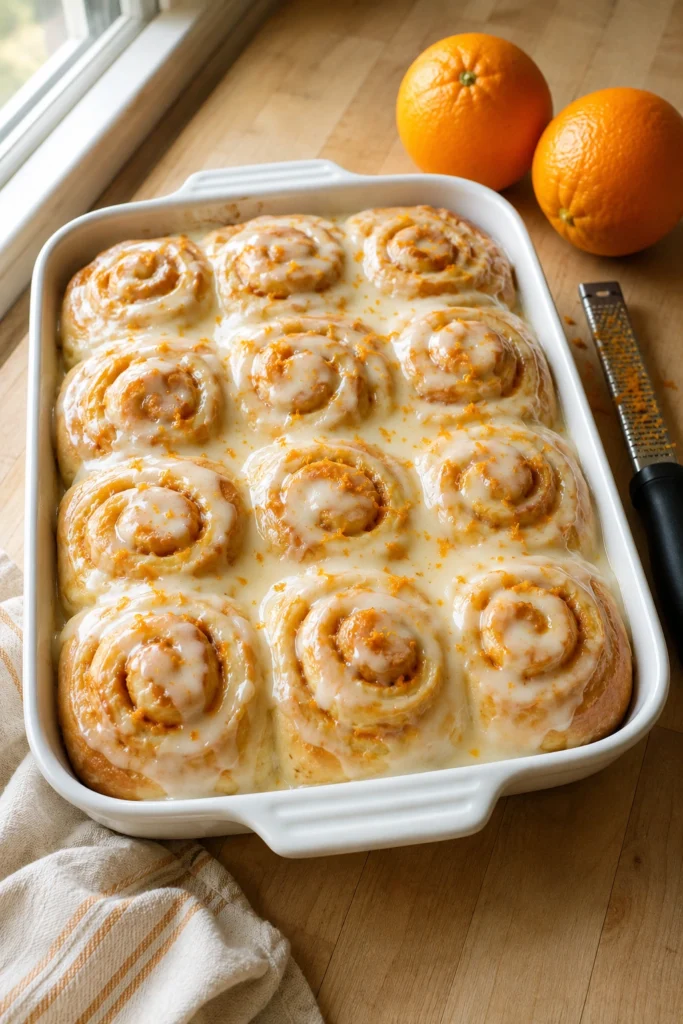
Key Ingredients for Orange Creamsicle Rolls
Fresh Oranges The entire recipe is built around the flavor of real fresh oranges, and there is simply no substitute. You will need the zest and juice of approximately three to four large navel oranges across all three components. Navel oranges are ideal because they are consistently sweet, abundantly juicy, and produce a large amount of zest per fruit. Blood oranges make a stunning seasonal variation with a deeper, more complex flavor and a naturally pink-tinged glaze.
Active Dry Yeast The yeast is what gives these rolls their characteristic soft, pillowy texture. Active dry yeast needs to be proofed in warm liquid before being added to the dough — a five-minute step that confirms the yeast is alive and active before you commit an hour of rising time to the recipe. Instant yeast can be substituted and mixed directly into the dry ingredients without proofing, but reduce the quantity by approximately 25 percent.
Whole Milk Whole milk contributes fat and protein to the dough that produces a richer, more tender crumb than lower-fat alternatives. It is also the liquid used to proof the yeast, so its temperature is critical. Do not substitute with skim or plant-based milk in the dough — the fat content is structurally important. If dairy-free is required, full-fat oat milk is the closest functional alternative.
Cream Cheese Used in the glaze and optionally swirled into the filling, cream cheese provides the “creamsicle” element — that tangy, rich, vanilla-forward creaminess that is the counterpoint to the bright orange. Full-fat block cream cheese is essential for a smooth, pourable glaze. Softened to room temperature before mixing, it blends seamlessly with the powdered sugar and orange juice without any lumps.
Unsalted Butter Butter appears in the dough, the filling, and optionally in the glaze. In the dough, it adds richness and tenderness. In the filling, softened butter is the base into which the orange zest and sugar are creamed, creating the sweet, aromatic swirl that runs through every roll. Use good quality butter — its flavor is prominent throughout.
Vanilla Extract The vanilla is the other half of the creamsicle identity. It appears in the dough, the filling, and the glaze, threading a warm, sweet note through the entire recipe that balances and deepens the brightness of the orange. Pure vanilla extract is strongly preferred over imitation — the difference is perceptible in a recipe where vanilla is a featured flavor rather than a background one.
How to Make Orange Creamsicle Rolls
For the Dough:
- Proof the yeast. Warm 240ml (1 cup) of whole milk to 38-43°C (100-110°F). Add 2.25 teaspoons (one standard packet) of active dry yeast and 1 teaspoon of granulated sugar. Stir gently and let sit for 5 to 7 minutes until foamy and fragrant. If the mixture does not foam, the yeast is not active — start again with fresh yeast.
- Mix the wet ingredients. In a large bowl or the bowl of a stand mixer, whisk together the proofed yeast mixture, 2 large room-temperature eggs, 60g (1/4 cup) of softened unsalted butter, 50g (1/4 cup) of granulated sugar, 1 teaspoon of pure vanilla extract, and the zest of one large orange.
- Add the flour. Add 480g (4 cups) of all-purpose flour and 1 teaspoon of fine salt. Mix with a dough hook on medium speed for 6 to 8 minutes, or knead by hand for 10 minutes, until the dough is smooth, slightly tacky, and pulls cleanly away from the sides of the bowl.
- First rise. Shape the dough into a ball and place in a lightly oiled bowl. Cover with plastic wrap or a clean kitchen towel and allow to rise in a warm place for 1 to 1.5 hours until doubled in size.
For the Orange Cream Filling:
- Make the filling. Beat 115g (1/2 cup) of softened unsalted butter with 150g (3/4 cup) of granulated sugar, the zest of two large oranges, and 1 teaspoon of pure vanilla extract until light, fragrant, and fully combined. Set aside at room temperature.
Shaping and Second Rise:
- Roll the dough. Punch down the risen dough and turn out onto a lightly floured surface. Roll into a large rectangle approximately 45x30cm (18×12 inches) and 0.5cm (1/4 inch) thick.
- Spread the filling. Spread the orange butter filling evenly over the entire surface of the dough, leaving a 1cm (1/2 inch) border along one long edge.
- Roll and slice. Starting from the long edge opposite the border, roll the dough tightly and evenly into a log. Use a sharp knife or unflavored dental floss to cut the log into 12 equal rolls, each approximately 4cm (1.5 inches) wide.
- Arrange and second rise. Place the rolls cut-side up in a greased 9×13 inch baking dish. Cover and allow to rise for 30 to 45 minutes until puffed and touching each other.
- Bake. Preheat your oven to 180°C (350°F). Bake the rolls for 22 to 26 minutes until golden on top and cooked through. The internal temperature should reach 88°C (190°F). Remove from the oven and rest for 5 to 10 minutes before glazing.
For the Orange Cream Cheese Glaze:
- Beat the cream cheese. Beat 115g (4oz) of softened full-fat cream cheese until completely smooth.
- Add remaining ingredients. Mix in 180g (1.5 cups) of powdered sugar, 3 tablespoons of fresh orange juice, the zest of one orange, and 1/2 teaspoon of pure vanilla extract. Whisk until silky, smooth, and pourable. Add additional orange juice one teaspoon at a time if needed to reach your desired consistency.
- Glaze the warm rolls. Pour the glaze generously over the warm rolls directly in the baking dish, allowing it to pool between the rolls and soak into every crevice. Serve immediately while warm.
Variations and Tips
Summer Desserts Gluten Free: Substitute the all-purpose flour with a high-quality 1:1 gluten free bread flour blend — one that contains xanthan gum for structure. Gluten free yeast doughs require slightly more liquid and a longer rise time, so add an additional 2 tablespoons of milk to the dough and allow both rises to extend by 15 to 20 minutes. The texture will be slightly denser but the flavor will be fully intact.
Summer Desserts Healthy Option: Reduce the sugar in the filling by a third and replace half the all-purpose flour with whole wheat flour for a slightly more wholesome dough with a nuttier flavor that complements the orange beautifully. The glaze can be made with reduced-fat cream cheese without significantly affecting the flavor.
Summer Desserts No Bake Variation: For a completely no-bake interpretation of these flavors, layer orange-vanilla pudding, whipped cream cheese, and crushed vanilla wafers in individual glasses and top with fresh orange segments and zest. It captures the creamsicle spirit without any baking whatsoever.
Summer Desserts with Fruit Enhancement: Add thin slices of candied orange peel to the filling before rolling, or press fresh orange supremes gently into the top of each glazed roll just before serving. The visual impact is extraordinary and the flavor deepens significantly.
Pro Tip: For the most defined, even swirls, refrigerate the shaped log for 15 minutes before slicing. The cold firms the butter filling just enough that it does not smear or compress when the knife cuts through, resulting in clean, beautiful spirals in every roll.
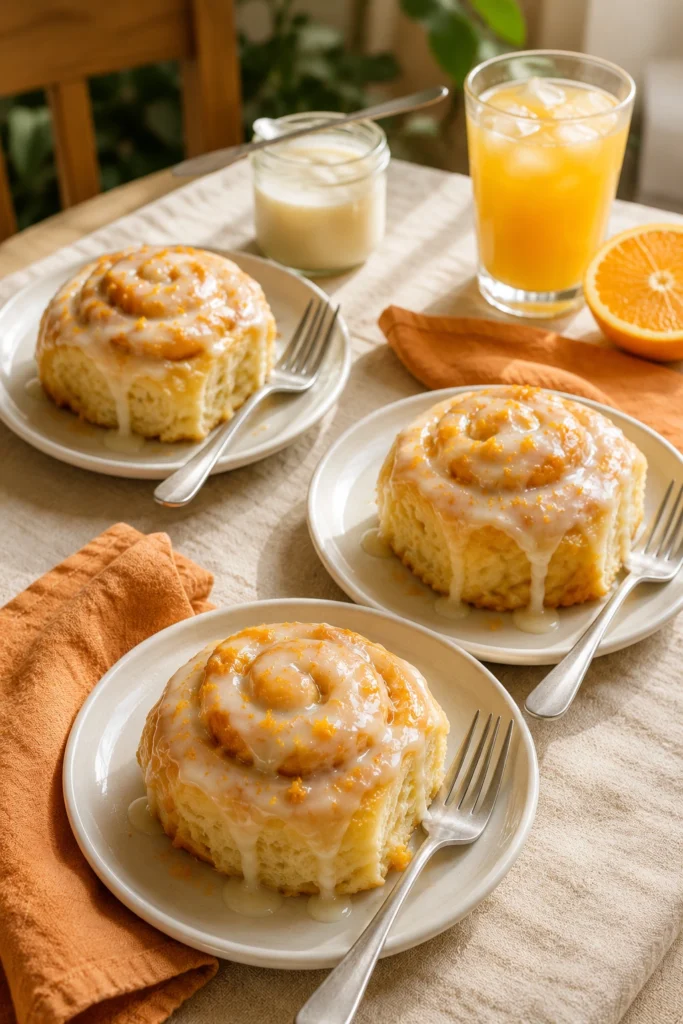
How to Meal Prep Orange Creamsicle Rolls
These rolls are exceptionally well-suited to overnight preparation, which makes them one of the most practical summer desserts for a crowd when you want a show-stopping result without a stressful morning.
After shaping the rolls and placing them in the baking dish, cover tightly with plastic wrap and refrigerate overnight rather than allowing the second rise to happen at room temperature. In the morning, remove the dish from the refrigerator and allow the rolls to sit at room temperature for 45 minutes to one hour before baking. They will complete their second rise during this time and bake exactly as described.
The glaze can also be made up to three days in advance and stored in a sealed container in the refrigerator. Allow it to come to room temperature and whisk briefly before using — it may thicken slightly in the refrigerator and benefit from an additional teaspoon of orange juice to restore its pourable consistency.
Fully baked and glazed rolls keep at room temperature covered for up to two days. To reheat individual rolls, microwave on medium power for 20 to 25 seconds — they return to their warm, soft, fresh-baked texture almost instantly, making them one of the most forgiving and convenient summer desserts for party hosting situations where food needs to be prepared ahead.
FAQs
Can I use store-bought crescent roll dough to save time? Yes, and it produces a genuinely delicious result with a fraction of the effort. Unroll two tubes of crescent roll dough, press the seams together into a rectangle, spread the orange filling over the surface, roll and slice as directed, and bake according to the package instructions. The texture will be flakier and less pillowy than a homemade yeast dough, but the flavor — especially with generous orange zest — is wonderfully satisfying.
My dough is not rising. What went wrong? The most likely cause is yeast that was killed by liquid that was too hot, or yeast that was already expired before use. Always check the expiration date on your yeast before beginning. If the proofed yeast mixture does not produce visible foam within 7 minutes, discard it and start the proofing step again with fresh yeast and liquid that has been carefully temperature-checked.
Can I make these rolls without a stand mixer? Absolutely. Hand kneading produces excellent results and actually gives you a better feel for when the dough has reached the right consistency. Knead on a lightly floured surface for a full 10 minutes — the dough is ready when it is smooth, slightly tacky but not sticky, and springs back slowly when poked with a finger.
How do I get the glaze to soak into the rolls rather than pool at the bottom? The key is glazing at the right temperature — warm but not hot — and using a glaze thin enough to flow freely between the rolls. If the glaze sets on the surface rather than soaking in, warm it briefly in the microwave for 10 seconds and add another teaspoon of orange juice to thin it slightly. Pouring slowly and in a circular motion over the entire pan gives the glaze time to find its way into every gap.
Cultural Context
The creamsicle — that beloved orange-and-vanilla frozen confection — was invented in 1905 by an eleven-year-old boy named Frank Epperson, who accidentally left a cup of flavored soda water with a stirring stick outside on a cold night and discovered the frozen treat concept by morning. His invention, eventually commercialized and licensed to the Popsicle brand, became one of the defining flavors of American summer food culture throughout the 20th century.
The orange and vanilla combination that defines a creamsicle has a flavor logic rooted in food science: the sharpness of citrus and the warmth of vanilla are natural counterpoints that balance and enhance each other. It is the same principle at work in orange blossom pastries across North African and Middle Eastern baking traditions, where orange water and vanilla appear together in countless classic recipes. The pairing is, in a sense, universal.
Transforming this frozen treat flavor into a baked roll format is a thoroughly contemporary approach — part of a broader movement in home baking that takes beloved flavor memories and reimagines them in new and unexpected formats. Cinnamon rolls were the template that made this category of dessert roll culturally ubiquitous, and the creative leap from cinnamon-sugar to orange-vanilla is one that makes immediate, instinctive sense to anyone who has ever loved both a warm roll and a summer creamsicle.
These Orange Creamsicle Rolls sit at the intersection of nostalgia and innovation — a dessert that feels both completely familiar and genuinely surprising, which is perhaps the most satisfying thing any summer dessert can aspire to be.
Orange Creamsicle Rolls
Equipment
- stand mixer with dough hook
- large mixing bowl
- Rolling Pin
- 9×13-inch baking dish
- zester or microplane
- whisk
- sharp knife or dental floss
Ingredients
- 240 ml whole milk, warmed to 38-43°C (100-110°F)
- 2.25 tsp active dry yeast
- 1 tsp granulated sugar
- 2 large room-temperature eggs
- 60 g softened unsalted butter
- 50 g granulated sugar
- 1 tsp pure vanilla extract
- 1 zest of one large orange
- 480 g all-purpose flour
- 1 tsp fine salt
- 115 g softened unsalted butter for filling
- 150 g granulated sugar for filling
- 2 zest of two large oranges
- 1 tsp pure vanilla extract for filling
- 115 g softened full-fat cream cheese
- 180 g powdered sugar
- 3 tbsp fresh orange juice
- 1 zest of one orange
- 0.5 tsp pure vanilla extract for glaze
Instructions
- Warm the whole milk to 38-43°C (100-110°F). Stir in the yeast and 1 teaspoon sugar. Let sit for 5 to 7 minutes until foamy.
- In a large bowl, whisk together the proofed yeast mixture, eggs, softened butter, sugar, vanilla extract, and orange zest.
- Add the flour and salt. Knead with a dough hook for 6 to 8 minutes or by hand for 10 minutes until smooth and slightly tacky.
- Place the dough in a lightly oiled bowl, cover, and let rise in a warm place for 1 to 1.5 hours until doubled in size.
- Beat the softened butter, sugar, orange zest, and vanilla extract for the filling until fully combined and fragrant.
- Punch down the dough and roll it into a 45x30cm rectangle about 0.5cm thick on a lightly floured surface.
- Spread the orange filling evenly across the dough, leaving a small border along one edge.
- Roll the dough tightly into a log and slice into 12 equal rolls using a sharp knife or dental floss.
- Arrange the rolls in a greased 9×13 inch baking dish. Cover and let rise for 30 to 45 minutes until puffed.
- Preheat the oven to 180°C (350°F). Bake the rolls for 22 to 26 minutes until golden brown and cooked through.
- Beat the cream cheese until smooth, then mix in powdered sugar, orange juice, orange zest, and vanilla extract until silky.
- Pour the glaze generously over the warm rolls and allow it to soak into the layers before serving.