
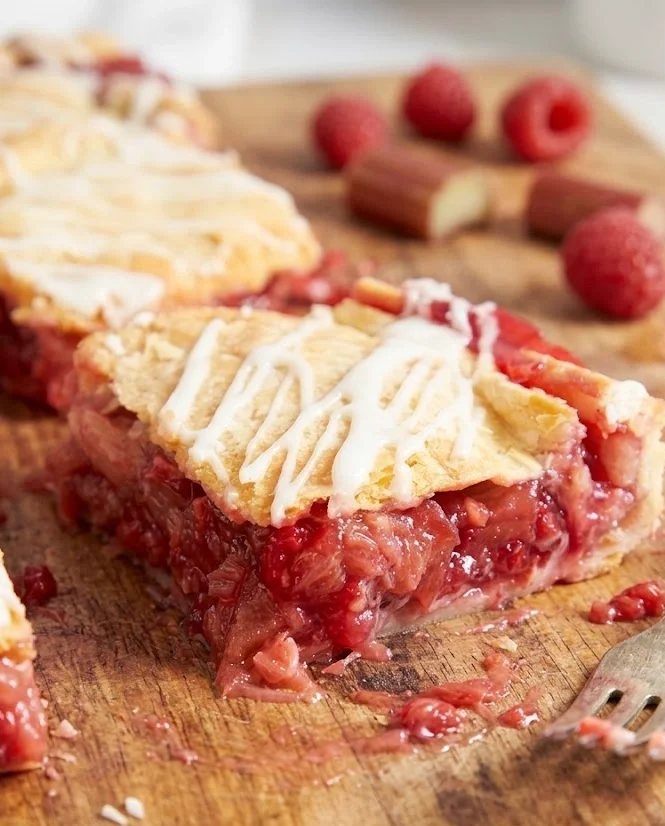
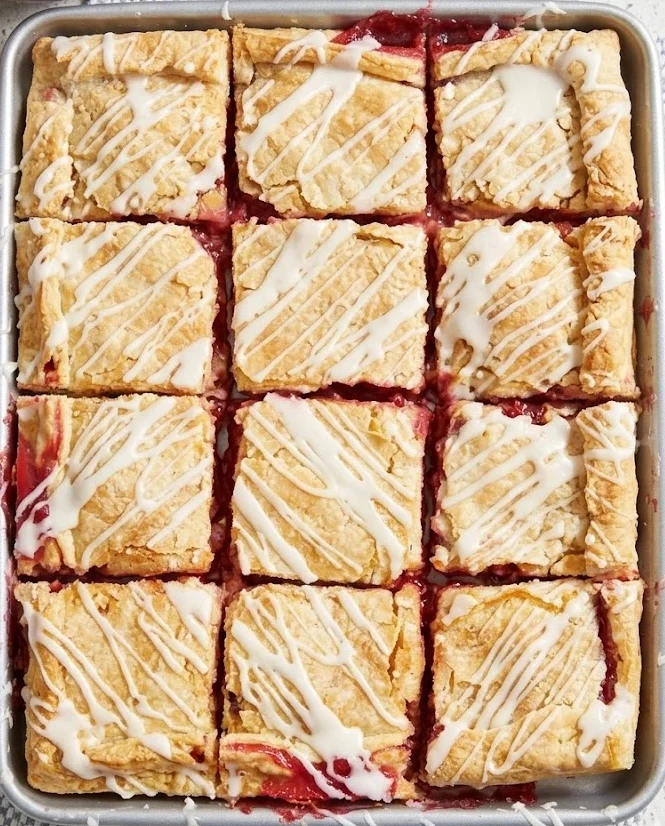
If you have ever wanted to make a rhubarb pie recipe for a crowd without the stress of pressing and crimping individual pie shells, a slab pie is the answer you did not know you were looking for. This raspberry rhubarb slab pie bakes in a standard jelly-roll pan, feeds twenty-four people from a single batch, and finishes with a drizzle of vanilla icing that makes it look like it came straight out of a bakery window.
It is one of those rhubarb recipes that works as well at a spring potluck as it does on a Tuesday night when you need to use up a bundle of rhubarb from the market. The format is forgiving, the flavors are bold, and every slice delivers more buttery crust per bite than a traditional round pie — which is exactly why slab pies deserve a much bigger place in every baker’s repertoire.
Why You’ll Love This Rhubarb Slab Pie
Among all the rhubarb recipes out there — rhubarb crisp, rhubarb cake, rhubarb muffins, rhubarb bars — pie holds a special, nostalgic place. And this slab format solves the biggest problem with traditional rhubarb pie recipes: the mess.
Because the filling is spread thin across a large pan, the fruit cooks evenly and the crust stays crisp on the bottom. There is no soggy bottom, no collapsing filling, and no awkward slicing of a round pie for a large group. You cut it into neat rectangles like bar cookies and serve them on a plate or straight from the pan.
The raspberries are not just a flavor addition here — they are a structural one. Their natural pectin helps the filling set more firmly than rhubarb alone would, and their deep pink color turns the filling into something visually dramatic and inviting. This is a genuinely beautiful dessert that requires no decoration beyond a simple drizzle of icing.
Common Mistakes (And How to Avoid Them)
A slab pie has a few unique challenges that a round pie does not. Here is what to watch for.
Adding too much liquid to the pastry dough. The recipe calls for three-quarters of a cup of milk plus an egg yolk, with room to add one to two more tablespoons of milk if absolutely necessary. Do not be tempted to add more than that. Extra liquid develops the gluten and produces a tough, leathery crust rather than a flaky one. Stop adding liquid the moment the dough just holds together when pressed.
Skipping the chilling step. After mixing the dough, dividing it, and wrapping it, it needs at least one hour in the refrigerator before rolling. Cold dough is firm, cooperative, and produces a flakier result because the butter stays solid until it hits the oven. Warm dough tears, sticks, and bakes up dense.
Not draining the fruit properly. If you are using frozen raspberries or frozen rhubarb, drain them thoroughly after thawing before mixing with the sugar and cornstarch. Undrained frozen fruit adds significant extra liquid to the filling and can overwhelm the cornstarch, resulting in a runny, wet interior.
Rolling the top crust too thick. The top crust needs to be rolled thin enough to cover the pan fully without being so thick that it stays doughy in the center. Aim for an even, consistent thickness slightly thinner than the bottom layer.
Cutting into the pie while it is warm. The filling needs to cool completely before slicing. Cornstarch sets as it cools — if you cut into a warm slab pie, the filling will run and the slices will not hold their shape. Give it the full cooling time on a wire rack before adding the icing and serving.
Chef’s Notes
The division of the dough is intentional and matters. The larger portion becomes the bottom crust and needs to be rolled to an 18×13-inch rectangle to cover the pan base and come up the sides. The smaller portion covers just the top. Do not split them evenly — keep that size difference so the bottom has enough dough to line the full pan.
Pricking the top crust all over with a fork before baking is not optional. Steam needs to escape during baking, and without those vents, the top crust will puff, bubble, and potentially burst in places rather than baking flat and golden.
The vanilla icing is deliberately simple — just powdered sugar, vanilla, and enough milk to drizzle. Resist the urge to make it thicker or frost the pie like a cake. A light drizzle is all it needs, and it adds both sweetness and visual appeal without overpowering the fruit.
For an alternative finish, brush the top crust with a beaten egg before baking and scatter turbinado sugar over it. This produces a crisp, caramel-colored, sugared crust in place of the icing — rustic and beautiful in its own way.
Key Ingredients
Fresh or frozen raspberries bring natural sweetness, deep pink color, and a subtle tartness that balances the sharpness of rhubarb perfectly. Five cups is a significant quantity, and that generosity is what makes the filling so vibrant. If using frozen, measure while still frozen, then thaw and drain fully before use.
Fresh or frozen rhubarb is the backbone of this recipe and the reason most people seek out rhubarb recipes in the first place. Its sharp, almost citrus-like tartness contrasts with the sweet pastry and icing in every bite. Three cups sliced thin ensures it cooks down completely in the oven without leaving tough, fibrous chunks.
Cornstarch is the thickener that turns the fruit juices into a glossy, sliceable filling. At a third of a cup for eight cups of total fruit, it is well-calibrated to handle the moisture without making the filling gummy or starchy.
Cold butter is the heart of the pastry. Cutting cold butter into flour by hand — using two knives, a pastry cutter, or your fingertips — creates the small pockets of fat that turn to steam in the oven and produce layers of flake in the finished crust. If your butter warms up during mixing, refrigerate the whole bowl for fifteen minutes before continuing.
An egg yolk in the pastry dough adds rich flavor and protein that helps bind the crust together without making it tough. It also contributes to the golden color of the baked crust.
Confectioners’ sugar forms the base of the simple vanilla icing. Its fine texture dissolves instantly into milk to create a smooth, pourable glaze that sets quickly on the cooled pie.
How to Make Raspberry Rhubarb Slab Pie
For the pastry:
- 3¼ cups all-purpose flour
- 1 tsp salt
- 1 cup cold unsalted butter, cut into small cubes
- ¾ cup plus 1 to 2 tbsp 2% milk
- 1 large egg yolk
For the filling:
- 2 cups granulated sugar
- ⅓ cup cornstarch
- 5 cups fresh or frozen raspberries, thawed and drained if frozen
- 3 cups fresh or frozen rhubarb, sliced, thawed and drained if frozen
For the vanilla icing:
- 1¼ cups confectioners’ sugar
- ½ tsp pure vanilla extract
- 5 to 6 tsp 2% milk
Instructions:
- In a large bowl, whisk together the flour and salt. Using a pastry cutter, two knives, or your fingertips, cut the cold butter into the flour until the mixture resembles coarse, sandy crumbs with some pea-sized pieces of butter remaining.
- Whisk the egg yolk into three-quarters of a cup of milk. Gradually pour the liquid into the flour mixture, tossing with a fork. Add additional milk one tablespoon at a time only if needed. Stop as soon as the dough just holds together when pressed.
- Divide the dough into two portions, making one slightly larger than the other. Wrap each in plastic wrap and refrigerate for at least one hour, or until firm enough to handle easily.
- Preheat the oven to 375°F (190°C).
- Remove the larger dough portion from the refrigerator. Roll it between two sheets of lightly floured waxed paper into an 18×13-inch rectangle. Using the waxed paper to help lift, transfer the crust to an ungreased 15x10x1-inch baking pan. Press the dough onto the bottom and up the sides of the pan. Trim any excess to line up with the pan edges.
- In a large bowl, combine the sugar and cornstarch. Add the raspberries and rhubarb and toss to coat evenly. Spoon the filling into the crust and spread it into an even layer.
- Roll out the remaining dough between sheets of floured waxed paper into a rectangle large enough to cover the pan. Lift and place it over the filling.
- Fold the edges of the bottom crust up over the edges of the top crust. Pinch firmly to seal, then press with a fork to create a sealed, decorative edge. Prick the entire top crust all over with a fork to allow steam to escape.
- Bake for 45 to 55 minutes, until the crust is deep golden brown and you can see the filling bubbling around the edges and through the fork holes.
- Transfer to a wire rack and cool completely.
- Whisk together the confectioners’ sugar, vanilla, and enough milk to achieve a thin, drizzleable consistency. Drizzle over the fully cooled pie with a spoon.
- Cut into rectangles to serve.
Looking for more ways to bake with rhubarb? This Ultimate Rhubarb Recipes Guide brings together 20 of the best easy, healthy, and impressive rhubarb recipes in one place — from classic strawberry rhubarb pie and golden rhubarb crisp to sourdough rhubarb bread, rhubarb muffins, rhubarb bars, and stunning celebration cakes. Whether you have fresh rhubarb or a bag in the freezer, you will find exactly the recipe you are looking for. Browse all 20 rhubarb recipes and discover your next favorite bake.
Variations and Tips
This raspberry rhubarb slab pie is one of the most adaptable rhubarb pie recipes in terms of fruit combinations and finishing options.
Change the fruit: Strawberry rhubarb is the most natural swap and produces one of the most searched strawberry rhubarb recipes in this format. Replace the raspberries with an equal amount of sliced strawberries for a filling that is slightly sweeter and more jammy. Blackberries, blueberries, or a combination of all three with rhubarb also work beautifully.
Add warm spice: A teaspoon of cinnamon, a half teaspoon of cardamom, or a pinch of star anise added to the sugar-cornstarch mixture deepens the filling flavor significantly. Fresh herbs like rosemary or lavender, used sparingly, add a sophisticated floral note that pairs surprisingly well with the tartness of rhubarb.
Crunchy sugar topping: Skip the icing and brush the top crust with a beaten egg instead. Scatter turbinado or cinnamon sugar over the egg wash before baking. The result is a beautifully crisp, caramel-colored crust that is rustic and stunning.
Gluten-free: A 1:1 gluten-free baking flour can replace the all-purpose flour in the pastry. The crust will be slightly more delicate and may crack when rolling, but pressing it back together in the pan works well. Handle the dough with extra care and keep everything cold.
Use store-bought pastry: If homemade pie dough feels like too much for a weeknight bake, two packages of refrigerated pie crust, rolled out and pieced together, work as a practical substitute. The result will not have quite the same flake, but the filling is flavorful enough to carry the pie.
How to Meal Prep This Rhubarb Slab Pie
This is one of the rhubarb recipes best suited to advance preparation, and it holds up well over multiple days — which is rare for a fruit pie.
The pastry dough can be made up to three days in advance and kept wrapped tightly in the refrigerator, or frozen for up to one month. Thaw overnight in the fridge before rolling. The filling can be mixed together a day ahead and stored covered in the refrigerator. Give it a stir before spooning into the crust, as some liquid may have pooled at the bottom.
The fully baked and cooled slab pie keeps well at room temperature, loosely covered, for up to two days. Refrigerated in an airtight container or covered pan, it keeps for up to four days. The crust will soften slightly in the fridge, but a few minutes in a 350°F toaster oven or regular oven crisps it back up reliably.
For longer storage, the baked pie freezes extremely well. Wrap the entire pan tightly in two layers of plastic wrap followed by aluminum foil, or cut it into individual squares, wrap each separately, and freeze. It keeps in the freezer for up to two months. Defrost overnight in the refrigerator and bring to room temperature before serving. Add the vanilla icing fresh after thawing for the best appearance.
Cultural Context
The slab pie is one of those American baking traditions that never quite made it into mainstream recipe culture the way that round pies did — despite being older, more practical, and arguably better suited to feeding large groups. Its origins trace back to professional and farmhouse bakers who needed to produce large quantities of pastry efficiently. Baking in a sheet pan rather than individual pie dishes made obvious practical sense, and the rectangular format meant clean, even portions for every guest.
The recipe’s creator, Jeanne Ambrose of Milwaukee, Wisconsin, credits her grandfather — a professional baker — for introducing her to slab pie as a commercial bakery staple. It is a format that translates beautifully to home kitchens, precisely because it removes so many of the fussier elements of traditional pie-making.
Among rhubarb pie recipes specifically, the slab format deserves far more attention than it typically receives. Rhubarb’s high water content is actually better managed in the wide, shallow format of a slab pie than in the deep, round format of a traditional pie shell, where liquid can pool and steam the bottom crust. The thinner filling layer cooks faster, sets more firmly, and lets the cornstarch do its job more effectively.
Paired with raspberries — themselves a spring and early summer crop that overlaps with rhubarb season in most of North America — this pie represents something genuinely seasonal and celebratory. It sits alongside strawberry rhubarb recipes and rhubarb crisp as one of the great spring rhubarb desserts, and in the slab format, it might just be the easiest one to share.
Raspberry Rhubarb Slab Pie
Equipment
- mixing bowls
- pastry cutter or knives
- Rolling Pin
- 15×10-inch baking pan
- wire rack
Ingredients
- 3.25 cups all-purpose flour
- 1 tsp salt
- 1 cup cold unsalted butter, cubed
- 0.75 cup 2% milk
- 1 egg yolk
- 2 cups granulated sugar
- 0.33 cup cornstarch
- 5 cups raspberries (fresh or frozen, drained)
- 3 cups rhubarb, sliced (fresh or frozen, drained)
- 1.25 cups confectioners’ sugar
- 0.5 tsp vanilla extract
- 5 tsp milk (for icing)
Instructions
- Whisk together flour and salt, then cut in cold butter until crumbly with pea-sized pieces.
- Whisk egg yolk with milk and gradually add to the flour mixture until dough just comes together.
- Divide dough into two portions (one larger), wrap, and refrigerate for at least 1 hour.
- Preheat oven to 375°F (190°C). Roll out the larger dough and fit into a 15×10-inch pan.
- Mix sugar and cornstarch, then toss with raspberries and rhubarb. Spread evenly over crust.
- Roll out remaining dough and place over filling. Seal edges and prick top with a fork.
- Bake for 45–55 minutes until golden brown and bubbling. Cool completely on a wire rack.
- Mix confectioners’ sugar, vanilla, and milk to make icing. Drizzle over cooled pie, slice, and serve.